Gear
The Supply List for a Retriever Puppy
Ten things earn their place in the first week. Another twenty are bought a year too early and resold. This list separates the two, in the order the puppy will actually need them.
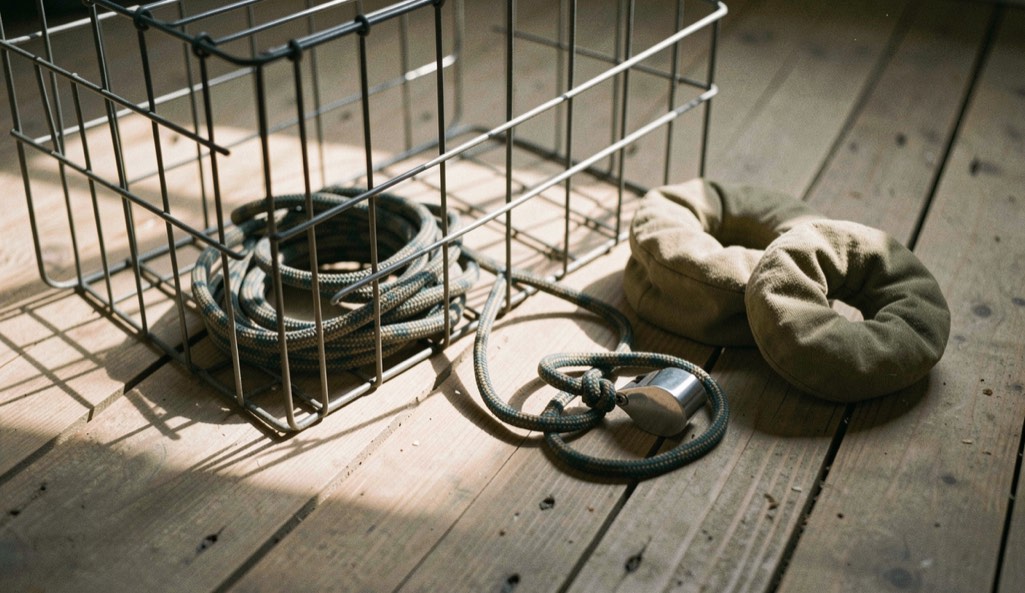
Ten things earn their place in the first week with a young retriever. Another twenty get bought a year too early, used twice and resold. The difference between the two lists is not quality and it is not money: it is whether the object serves an exercise the dog is actually doing now. This page sorts the shelf on that basis, in the order the dog will need it.
No brand is named and no price appears here, for the same reason as everywhere else in the gear section: models are discontinued and prices move, and a page built on either is wrong within a season. What is described is what each object is for, when it starts being useful, and what it makes unnecessary.
Buy for the first week, not for the first year
The first week is about arrival, safety and routine. The puppy has to sleep somewhere, travel somewhere, eat and drink somewhere, and be attached to you when it goes outside. That is the entire requirement, and a household that has those four solved will not be caught out by anything.
Everything else on the shelf is training equipment, and training equipment has a start date. A whistle bought in the first week is a whistle that gets blown for fun and stops meaning anything. A launcher bought in the first month is a launcher that sits in a garage for a year. The rule that saves the most money is simply this: if you cannot name the exercise the object serves, in the calendar the dog is currently on, it is not time to buy it. That calendar is set out in the first months.
The crate, the collar and the check cord
The crate is the one object that will be in continuous use for the dog's whole working life, so it is worth getting right rather than getting cheap. It has to fit the vehicle first and the house second, because a crate that will not travel means the dog travels loose, and a dog that travels loose is a dog that arrives at ground unsettled and leaves it wet and unsecured. Size for the adult dog and reduce the space inside while the puppy is small.
The collar is a flat collar, and it matters more than it sounds because it is the collar the dog will wear at an entry level test: the AKC hunting test regulations, read at the source on September 2, 2026, allow a Junior dog to be brought to the line on lead with a flat collar and gently restrained. A puppy that has only ever worn something else will meet that piece of equipment for the first time on the wrong day.
The check cord is the third object and the most useful of the three for training. It is a long line that lets a young dog be a long way away while still being connected, which is exactly the condition under which a recall gets built honestly. It is not a correction device. It is a way of making sure the dog never learns that distance means the command is optional.
Whistles, bumpers and the size question
Buy two identical whistles on one lanyard, because a lost whistle in a field ends a session and a different whistle sounds different to the dog. The whistle does not come out until the sit is being built on land at short distance, and until then it lives in a drawer.
Bumpers for a young dog are chosen on one criterion: can the dog take a full, comfortable grip in the middle without repositioning. Everything else is secondary. A bumper that is slightly too big produces a dog that shifts its hold, and a dog that shifts its hold is well on the way to mouthing, which is expensive to fix and easy to avoid. Two or three small canvas bumpers cover the entire first year. The adult version of this shelf, including throwing equipment, is covered in bumpers and launchers.
| Object | When it starts being useful | What it replaces or prevents |
|---|---|---|
| Travel crate, sized for the adult dog | Before the puppy arrives. | A loose dog in a vehicle, and a second crate bought six months later. |
| Flat collar and a short lead | Day one. | Meeting the flat collar for the first time at an entry level test. |
| Food and water bowls, and a travel water container | Day one. | A dog that will not drink away from home. |
| Check cord | As soon as the recall goes beyond a few paces. | A recall that becomes negotiable at distance. |
| Two small canvas bumpers | When short happy singles begin. | An oversized bumper and the mouthing habit that follows it. |
| Two identical whistles on one lanyard | When the sit is being built on land, and not before. | A whistle that has been blown for fun and means nothing. |
| Old towels, and one that stays in the vehicle | From the first water entry. | A wet dog drying in a cold crate on the drive home. |
| Stakes, flags and surveyor tape | When you start setting the same test twice on purpose. | Ground that cannot be reproduced, and sessions that are never comparable. |
| Neoprene vest | When the dog is working real cold water, not before. | Nothing, if bought early. It will be outgrown unused. |
| Launchers, wingers, electronic equipment | Second year at the earliest, once there is a multiple to set. | A garage full of equipment bought for a dog that was running singles. |
Water, drying and the truck
Three things belong together because they are all part of one moment: the dog comes out of the water and goes home. Old towels are better than a single expensive one, because what matters is drying the chest, the belly and the groin rather than polishing the back, and that takes more cloth than people expect. A dry blanket or a fitted coat traps air and does more than a towel once the dog is in the vehicle.
The vehicle itself is the piece of equipment nobody counts. A warm vehicle before the dog gets in, a crate that is dry, and a habit of moving the dog between the water and the truck rather than standing still, are worth more than any single object on this list. The reasoning behind all of that, and the signs that end a session, are in cold water work.
The first week, complete
- A travel crate that fits the vehicle, with the space reduced while the puppy is small.
- A flat collar and a short lead, worn from the first day so neither is ever a novelty.
- Bowls at home and a container that carries water in the vehicle.
- Bedding that can be washed and replaced without ceremony.
- Two or three old towels, one of which lives permanently in the truck.
- Something safe to carry, small enough for a full grip, and nothing that gets taken away roughly.
- A written record of what the dog has had and when, kept from the first day so the paperwork is never reconstructed from memory.
What to leave in the shop for now
Leave the launcher, the winger and everything electronic. Leave the vest, which will be outgrown before there is cold water work to do in it. Leave the second crate, the specialist bag, the tracking equipment and the collection of bumpers in six sizes. None of those serves an exercise a young dog is doing, and every one of them is cheaper to buy later against a specific need than now against a general intention.
Leave, above all, anything bought to make the dog look like a working dog. The list that matters is short, unglamorous and almost entirely about sleeping, traveling and being connected to a handler. What to check before the litter is even chosen is a different question, and it is handled in finding a reputable breeder.
Common mistakes
- Buying a puppy sized crate. Size for the adult dog, size for the vehicle, and reduce the space inside.
- Choosing a bumper the dog cannot fully grip. It is the fastest route to a mouthing habit that lasts for years.
- Introducing the whistle before there is anything for it to mean. It becomes background noise in a week.
- Buying a vest for a puppy. It will be outgrown before there is any cold water work to do in it.
- Using the check cord as a correction. It exists so that distance never teaches the dog that a command is optional.
- Drying only the back. The heat is lost from the chest, the belly and the groin.
- Buying training equipment for a dog that has no exercise to use it on. Name the exercise first, then buy.