Training
Cold Water Work and What It Costs a Dog
Cold water is a dose, not a temperature. How cold, for how long, how often, and what the dog looks like coming out: those four together decide whether a session was training or damage.
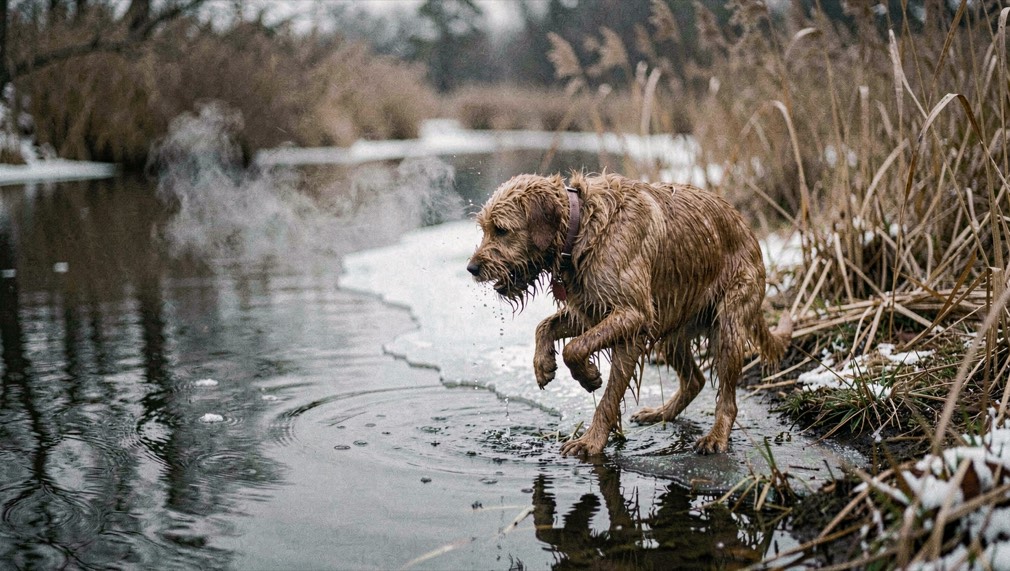
In the Northeast the water is cold for most of the year that anyone wants to train in, and cold water is the one part of retriever work where a bad decision costs the dog rather than the session. This page treats it as a question of exposure and observation rather than of courage, and it stops at the point where the subject becomes medical. Nothing here is veterinary advice: anything about a particular dog belongs with a veterinarian who can examine it.
No temperature threshold and no duration appears on this page. None has been read at the source for this site, and a threshold copied from a forum is worse than no threshold at all, because it converts a judgment that has to be made in front of the dog into a number that feels like permission. What is published instead is the principle, the observable signs, and the structure of a session that respects both.
Cold water is a dose, not a temperature
The useful way to think about cold water is as a dose: how cold, multiplied by how long, multiplied by how often, and modified by everything the dog is doing while it is wet. A short swim in genuinely cold water can cost a dog very little. A long series of retrieves in water that felt tolerable on the first entry can cost a great deal, and the dog will not tell you where the line was until it has been crossed.
Three variables move that dose and none of them is the water. Air temperature and wind decide what happens between retrieves, which is where most of the cooling actually occurs. The dog's own condition matters: a fit dog in working weight has more to spend than a dog that has been off all summer. And the amount of work matters in both directions, because a dog that is swimming hard generates heat while a dog that is sitting wet and waiting does not.
That last point is the one that catches experienced handlers out. The session that is dangerous is rarely the one with the hardest retrieves. It is the one with long gaps, a wet dog, a cold wind and a handler who is still talking about setting up the next mark.
What a wet coat does and does not do
A retriever coat is a real piece of engineering and it is routinely credited with more than it does. Dry, a dense double coat traps a layer of air that insulates well. Wet, most of that trapped air is gone, and what remains is a coat that sheds water quickly when the dog shakes and dries faster than a flat coat would. That is a genuine advantage, and it is an advantage in recovery rather than in immunity.
Two dogs of the same breed will differ more than the breed averages suggest, because coat density varies enormously within working lines, and so does body condition. A lean, hard, fit dog has less insulation and more capacity to generate heat than a heavier one, which is not a simple trade in either direction. The honest summary is that coat buys a dog time, not permission, and that time is shorter in wind than in still air.
| What the day looks like | What changes for the dog | What the session should look like |
|---|---|---|
| Warm water, warm air, no wind | Very little. Heat, not cold, becomes the limiting factor. | Normal work. Watch for overheating instead, and offer water to drink. |
| Cool water, mild air, light wind | The dog cools between retrieves rather than during them. | Keep the dog working or moving between setups instead of sitting wet. |
| Cold water, cold air, wind | The wet coat loses most of its insulating value and the wind takes the rest. | Short, few, decisive. Set up before the dog gets wet, not after. |
| Cold water, long waits, a wet dog held at a post | The worst combination in the sport: no work, no heat generated, constant loss. | Dry the dog between turns, or do not put it in the water until the wait is over. |
| Skim ice at the edges, or ice the dog must break | Entry and exit become the risk rather than the swim. | Do not send. There is no retrieve worth an uncertain exit. |
| Any of the above, in a dog that has not swum since summer | Condition, not weather, is the limiting factor. | Rebuild gradually. The first cold session of a year is never the one to test limits in. |
The signs that end the session
The decision to stop is made by watching the dog, and the useful signs are behavioral before they are anything else. Shivering that continues once the dog is moving. A slower return than the outward run, when the outward run was normal. A dog that stops wanting the retrieve, or takes it and comes back at a walk. Stiffness in the way it moves off the mark. A dog that will not go back into the water it entered happily fifteen minutes ago, which is the clearest statement a dog can make.
None of those is a diagnosis and none is a threshold. They are the point at which the session is over, without discussion and without one more retrieve to end on a good note. The one more retrieve is the classic error, because it is made precisely when the handler has already noticed something is wrong and wants to close the day cleanly.
Anything beyond that, meaning a dog that does not recover normally once warm and dry, is a veterinary question and not a training one. This publication does not give protocols, dosages or diagnoses, and a dog that worries you belongs in front of someone who can examine it the same day.
Ending a cold water session
- Stop while the dog still wants another one. That is the only reliable margin available.
- Let the dog shake properly before anything else, several times, out of the wind.
- Dry the chest, the belly and the groin rather than the back, because that is where a coat holds water and where the dog loses heat.
- Move the dog. A short walk generates more warmth than any amount of standing still under a towel.
- Warm the vehicle before the dog goes into it, not after, and never leave a wet dog in a cold crate to settle.
- Offer water to drink. Cold work dehydrates dogs quietly, and a dog that will not drink is worth noticing.
- Check the dog again an hour later, at home, warm and dry, and treat anything unusual as a question for a veterinarian.
Drying, warming and the drive home
The drive home is part of the session and it is the part most often got wrong. A wet dog in a cold vehicle continues to lose heat for the whole journey, in a confined space, without the ability to move enough to generate any. A dog that came out of the water in reasonable shape can arrive home in worse condition than it left the bank.
What actually helps is unglamorous: a towel used properly on the underside, a dry blanket or a fitted coat that traps air, a vehicle that is warm before the dog gets in, and enough movement between the water and the truck to keep circulation up. What helps less than people think is a big absorbent towel used only on the back, because the back is the part of the coat that sheds water on its own. The equipment side of this is covered in the gear section.
Building water tolerance across the year
Tolerance for cold water is built by a season, not by a session, and it is built at the front of the year rather than at the back. A dog that has been swimming regularly since the water opened arrives at the cold months fitter, better conditioned and better coated than a dog whose first swim of the autumn is in November. That is the strongest argument for the shape of the working year described in how a trial year is built: the calendar follows the water for good reasons, and one of them is the dog.
Two things do not build tolerance. Repeated short exposures to water that is too cold do not harden a dog, they simply accumulate a dose. And a screening certificate does not change any of this: a dog with clear structural and genetic results is a dog with a known heritable risk profile, not a dog that cannot get cold or hurt. That distinction is set out in retriever health clearances. The hunting day version of the same problem, where the dog is wet, still and waiting for hours, is described in the dog in the blind.
Common mistakes
- Reading a temperature instead of the dog. The same water is a different dose depending on wind, waiting time and condition.
- Training the dose upward on purpose. Cold tolerance is a by-product of a season of work, not a target to push at.
- The one more retrieve to end well. It is always taken after the handler has already seen the sign that should have ended the session.
- Drying the back and calling it done. The heat is lost from the chest, the belly and the groin.
- Loading a wet dog into a cold vehicle. The drive is part of the exposure and often the longest part of it.
- Sending a dog through ice at the edge. The swim is rarely the problem; the exit is.
- Treating a slow recovery as toughness. A dog that is not itself once warm and dry is a question for a veterinarian, not for a training plan.