Waterfowl
The Dog in the Blind
Most of a hunting day is spent sitting still. Everything the organized programs ask for, from steadiness to honoring, exists because of what happens in the twenty seconds that follow.
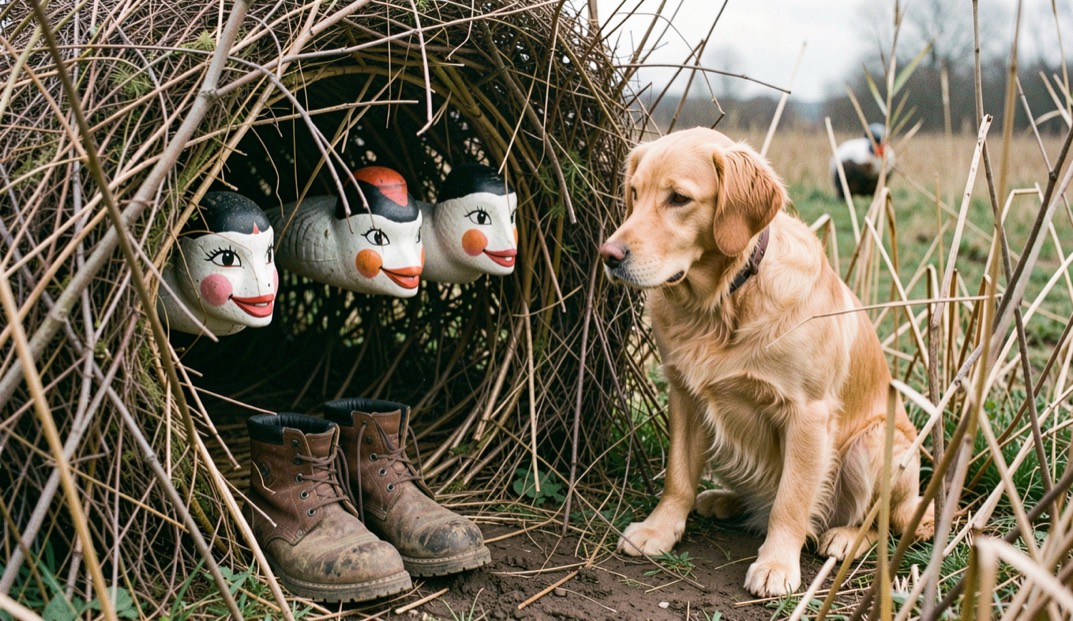
Every level in the American retriever programs is an attempt to reproduce, under rules, something a dog was already doing on a waterfowl hunt. Read the rulebooks without that origin and they look arbitrary. Read them with it and they become obvious: honoring exists because two dogs share one blind, steadiness exists because a dog that leaves early ends up in the decoy spread, and multiple marks exist because birds come down in groups.
What the origin also explains is the biggest single difference between a test and a hunting day, which is not difficulty. It is duration. A test compresses the interesting parts of a hunt into a few designed sequences. A hunt gives a dog long stretches of nothing, then twenty seconds where everything happens at once, then more nothing.
Most of the day is waiting
The dominant skill on a hunting day is not retrieving. It is sitting still, wet, cold and interested, for hours, with birds moving in the sky that the dog is not going to be sent for. A dog that is brilliant on three marks and cannot hold a position for forty minutes is not a hunting dog yet, whatever its training log says.
That waiting is also where the dog spends the most and gains the least. A working dog generates heat; a waiting dog does not, and a wet waiting dog in wind loses it steadily. This is the single situation in the whole sport where the arithmetic is worst, which is why the drying and warming question belongs to the hunting day even more than to the training field. The principle behind it, and the signs that end the day, are set out in cold water work.
Preparing a dog for the waiting is unglamorous and it is the part most training programs skip. It is built the same way everything else is: short at first, in a place where success is easy, then longer, then with distractions, then with birds moving. A dog that has only ever sat still for the length of a training setup has been prepared for a test rather than for a day.
Marking through a decoy spread
Marking on a training field is done across open ground with nothing in the way. Marking on a hunting day is done across water covered in objects that look, to a dog, quite a lot like the thing it has been sent for. That is a different problem, and a dog that has never been asked to solve it will solve it wrongly the first time.
Two behaviors come out of that. The first is a dog that stops at the spread and investigates, which costs time and occasionally costs the bird. The second, and the one that matters, is a dog that picks up a decoy, which is not merely embarrassing: it is a dog making exactly the decision that a switch is made of, on a day when nobody is scoring it and the habit is being installed for free.
The preparation is straightforward and rarely done. Put decoys out on the water where the dog trains, before the season, and set marks that require the dog to swim through them and ignore them. Do it until it is boring. A dog that has swum a spread twenty times in July will swim it without comment in November.
Working from a boat or a platform
Getting into and out of the water is where the real risk sits on a hunting day, and it is entirely a matter of what the dog is sitting on. A dog on a bank with a gentle shelving entry has no problem. A dog on a platform, a dock, a boat gunwale or a layout has to enter and, far harder, get back out, carrying something, tired, in cold water, with a slippery surface and nothing to push against.
Every part of that is trainable and none of it should be discovered on the day. Entry from a raised surface, re-entry onto it, waiting on it while another dog works, and moving on it without unbalancing anything are all separate exercises. A dog that has practiced them treats them as furniture. A dog that has not treats them as an obstacle, at the moment when it is most tired.
| Element | What an organized test asks | What a hunting day asks |
|---|---|---|
| Duration | A sequence of designed setups, each a few minutes long, with the dog worked between waits. | Hours of stillness broken by short bursts, in whatever order the birds decide. |
| Marking | Falls placed by people who intend the dog to be able to mark them. | Falls wherever they happen, through decoys, into cover, in poor light. |
| Steadiness | Held through a throw and a shot, at a set line, for a known duration. | Held for an unknown duration, with birds working the spread and nothing happening. |
| Honoring | Required at least once at AKC Senior and mandatory at Master. Read in the regulations on September 2, 2026. | The normal condition of a blind with two dogs in it, all day. |
| Delivery | To hand, required from Junior onward. | Frequently to the boot, which is forgiven on a hunt and fails a test. |
| The surface underfoot | A mown line, a bank, a known entry. | A platform, a boat, a dock, mud, or ice at the margin. |
| The cripple | Not part of any test. | The hardest single job of the day: a moving bird, in water, in flat light, at distance. |
Safety at the post, from cold to the way out
Three risks account for most bad days and none of them is the retrieve. The first is cold, and it is worse at the post than anywhere else because the dog is wet and doing nothing. The second is the entry and exit, which is where a tired dog with a bird in its mouth gets into trouble on a raised or slippery surface. The third is everything moving around the blind: other dogs, other people, boats, and the walk in and out in the dark at both ends of the day.
The gun is not a subject on this site beyond one point: it is a noise the dog has learned to treat as ordinary, and a dog that has not learned that has no business at a post. Nothing else about firearms belongs on a page about dogs, and nothing else appears here.
Preparing a dog for the day rather than for the test
- Train the wait. Build stillness in increments until the dog can hold a position far longer than any setup requires.
- Put decoys in the training water in warm weather and swim the dog through them until it is dull.
- Practice entry and exit from whatever surface the dog will actually work from, empty handed first and carrying afterwards.
- Work the dog beside another dog doing the job, repeatedly, so that honoring is the normal condition rather than an exercise.
- Rehearse the walk in and the walk out in poor light, with equipment, before it matters.
- Dry the dog between the water and the wait whenever the wait is going to be long.
- Decide in advance what will end the day, and honor it when the dog shows you.
Where the test and the hunt part ways
A test can reproduce a fall, a diversion, a long swim and the requirement to sit beside a working dog. It cannot reproduce duration, and it does not try to reproduce a cripple. That is why a dog that looks polished on a training field can come apart on its third hunting day, and why a dog that hunts well every season can still be surprised by what a test asks of its delivery.
The gap runs both ways, and both directions are worth respecting. A hunting day forgives a delivery that ends at the boot, and a test does not. A test never asks a dog to work a bird that is swimming away, and a hunting day does. Anyone moving between the two should read the requirements they are actually going to be measured against in hunt tests, level by level, and the mechanism that decides when the season happens at all in how seasons are set. The equipment the day imposes, which training largely ignores, is covered in the gear section.
Common mistakes
- Training retrieves and calling the dog ready. The dominant skill of the day is waiting, and it is the one nobody rehearses.
- Meeting decoys for the first time in season. A dog that picks one up is practicing the decision a switch is made of.
- Discovering the platform on the day. Entry is easy and exit is not, especially tired, wet and carrying something.
- Letting delivery slide because the hunt forgives it. It is required from the lowest test level upward, and habits do not sort themselves by context.
- Leaving a wet dog to sit through a long wait. That is the worst combination of exposure in the whole sport.
- Assuming a dog that honors in a test will honor all day. One setup is not four hours.
- Treating a difficult cripple as a training failure. It is the hardest job in the day and no test asks for it.