Trials & Tests
AKC Retriever Field Trials, Stake by Stake
A field trial places dogs against each other rather than against a standard, and that single difference changes the ground, the distances and the way a series is judged.
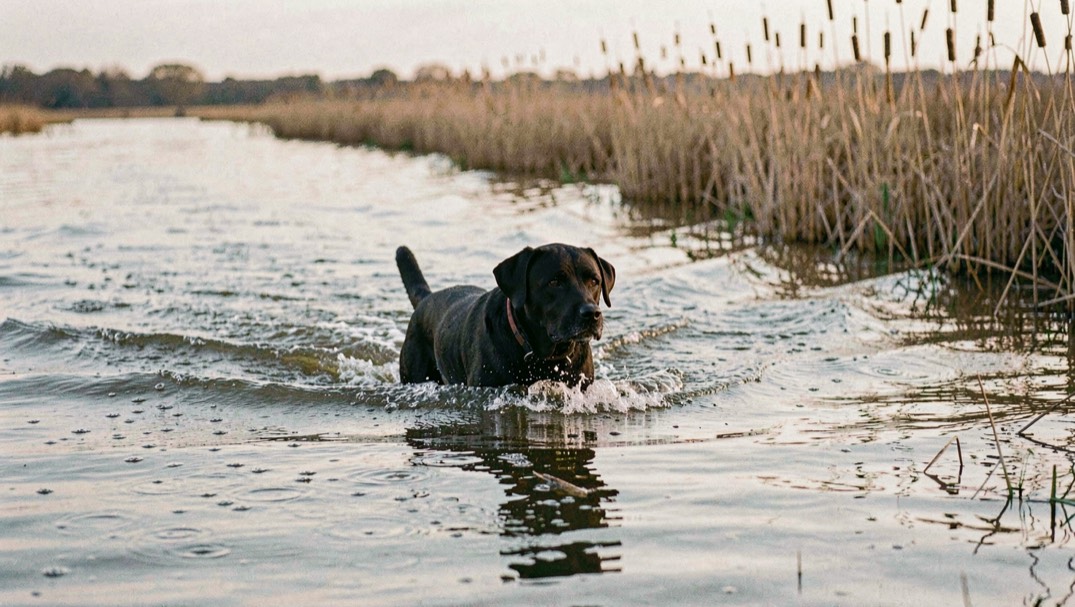
A field trial is the oldest and most demanding form of organized retriever work in the United States, and it runs on a different principle from a hunting test. In a test the dog is measured against a written standard, and every dog that meets it passes. In a trial the dogs are placed against one another: the judges look for the best performances of the day and thin the field series by series until a placing can be defended. That single difference explains nearly everything else about the circuit, from the ground it needs to the way a report reads.
One caution belongs at the top of this page rather than in a footnote. The registration and field trial rules and standard procedure for retrievers have not yet been read at the source for this site. Nothing here states an age condition, an eligibility rule, a points figure or a distance, because none of those has been read in the governing document. What follows describes the shape of the circuit and the vocabulary attached to it, and the page will be revised, with chapter and section, on the day the rulebook is read. The reading status of every document is published in sources and method.
What separates a field trial from a hunt test
The clearest way to hold the two apart is to ask what a good performance is worth. In a test, a good run is worth a pass, and it is worth the same pass whether four dogs ran that day or forty. In a trial, a good run is worth whatever the rest of the entry leaves it worth. Two identical performances can end the day in a placing or out of the callbacks depending entirely on who else came.
The consequence for the dog is that a trial has no ceiling. A test asks the questions its standard requires and stops; a trial keeps asking until the field separates, which in practice means longer marks, heavier terrain, more falls to hold in memory and blinds that punish a line which is only nearly right. The consequence for the handler is that preparation is open ended as well, and it is why the trial circuit and the test circuit produce visibly different training programs out of the same puppy. Readers deciding between the two will find the scored alternative described level by level in hunt tests, level by level.
The stakes, from the young dog stake to All-Age
A trial is not one competition but several run at the same meeting, each called a stake. The names used in entries and in written reports are the Derby, the Qualifying, the Open All-Age and the Amateur All-Age, with two further All-Age stakes, the Limited and the Special, that restrict who may enter on the strength of previous placings. Those names are the ones the sport uses; the conditions attached to each of them live in the rulebook, and until that document has been read here the table below records what each name is understood to cover and leaves the rule column empty rather than filling it from somewhere else.
| Stake | What the name is understood to cover | What the rulebook states | Who holds the leash |
|---|---|---|---|
| Derby | The stake for young dogs, run on marks, where a promising dog is first seen by a wider circuit. | Not read at the source on September 2, 2026. No age condition is printed here.Handlers speak of the Derby as the shop window of a litter, which is a judgment about reputation and not a rule. | Open to any handler. |
| Qualifying | The intermediate step, where blinds and the full apparatus of the circuit arrive together. | Not read at the source on September 2, 2026. | Open to any handler. |
| Open All-Age | The senior stake, open to the strongest dogs in the sport whoever is running them. | Not read at the source on September 2, 2026. Championship points are awarded in the All-Age stakes. | Open, professionals included. |
| Amateur All-Age | The same level of work, restricted to handlers running under amateur status. | Not read at the source on September 2, 2026. Championship points are awarded in the All-Age stakes. | Amateur handlers only. |
| Limited and Special All-Age | All-Age stakes whose entry is restricted by what a dog has already placed in. | Not read at the source on September 2, 2026. The restrictions are set in the rulebook. | Depends on the stake. |
How a series runs: callbacks, honor and no birds
A stake is run in series. Every dog entered runs the first series, and at the end of it the judges call back the dogs they want to see again. The dogs that are not called back are finished for the weekend. The next series is set for the shorter list, and it is normally harder, because the point of a series is no longer to test the field but to separate it. That is why a trial can look deceptively gentle at nine in the morning and brutal by four in the afternoon.
Two situations interrupt that rhythm often enough to be worth naming. Honoring is the requirement that a dog sit beside a working dog and do nothing while the other dog is sent, which is not politeness but a direct copy of two dogs in one blind. A no bird is a throw that goes wrong, a bird that falls where the dog cannot fairly be asked to work it, or a mechanical failure at the station; the dog is stopped, the series is reset for that dog, and nothing that happened counts. A handler who has never seen one usually mistakes it for a failure. The full vocabulary is set out in the glossary of the line.
What to watch on your first day at a trial
- Where the line is set, and what the wind is doing across the fall area rather than at the line itself.
- Whether a dog goes on a line to the fall or hunts the area, which is the distinction judges are separating on.
- The honor dog rather than the working dog, at least once, because that is where most of the day's tension actually sits.
- What happens after a whistle: whether the dog stops and looks, or stops and keeps drifting on its old line.
- How the callback list shrinks between series, and how much harder the next test is set for the dogs left in.
- The marshaling, the running order and the waiting, which take up far more of the day than the retrieves do.
Points, placements and the FC and AFC titles
Dogs that finish a stake are placed, first through fourth, and judges may also award further recognitions below the placings. Those recognitions are the reason a report can list far more dogs than there are placings, and their exact meaning belongs to the rulebook rather than to habit. What can be said without the reading is the structure: championship titles are earned by accumulating points in the All-Age stakes, the Field Champion title through the Open route and the Amateur Field Champion title through amateur handling. The point schedule behind both is published in the rulebook and is not printed here until it has been read there.
This matters to anyone reading a pedigree rather than watching a trial. A title in front of a registered name is a field trial championship earned in that way; the suffix letters after a name come from the hunting test programs and mean something different. Both are decoded in the stakes and levels table, and the way a written result is laid out is taken apart in reading trial results.
Common mistakes
- Reading a trial as a harder hunting test. It is a different kind of event: a placing is relative to the entry, a pass is not, and training for one does not automatically prepare a dog for the other.
- Quoting a distance as a requirement. Distances are built by the judges from the land, the water and the wind they have on the day, and no distance appears on this page for that reason.
- Treating a no bird as a failure. It is a reset, it costs nothing on the scoresheet, and a handler who reacts to it as a disaster hands the dog a problem that did not exist.
- Assuming the callback list is a ranking. It is a decision about who the judges still need to see, not an order of merit at that point in the day.
- Believing an Amateur All-Age placing is worth less than an Open one because the field is restricted. The work asked of the dog is the same; what changes is who is allowed to handle it.
- Entering a young dog in an All-Age stake to see how it goes. The stakes exist as a progression for a reason, even though climbing them in order is a training decision rather than an obligation.
What the rulebook fixes and what the judge decides
The reason this page is careful is that the field trial is where the gap between rule and habit is widest. A great deal of what circulates about trials quotes a distance, a bird count or an age as though a document had set it. Some of those figures are in the rulebook and some are the practice of a region, a set of grounds or a generation of judges, and a reader has no way of telling which is which from a forum post.
The method this site follows is to keep the two apart in separate fields, to print the edition and the section behind anything stated as a rule, and to say plainly when a document has not been read rather than repeat what everyone repeats. Until the field trial rules are read at the source, this page describes the circuit and holds its numbers back. When they are read, the table above fills in, the row carries its chapter and its date, and the change is announced in notes and rule updates. The two retrieves every stake is built on are taken apart in marks and blinds, and the shape of the season the stakes sit in is described in how a trial year is built.